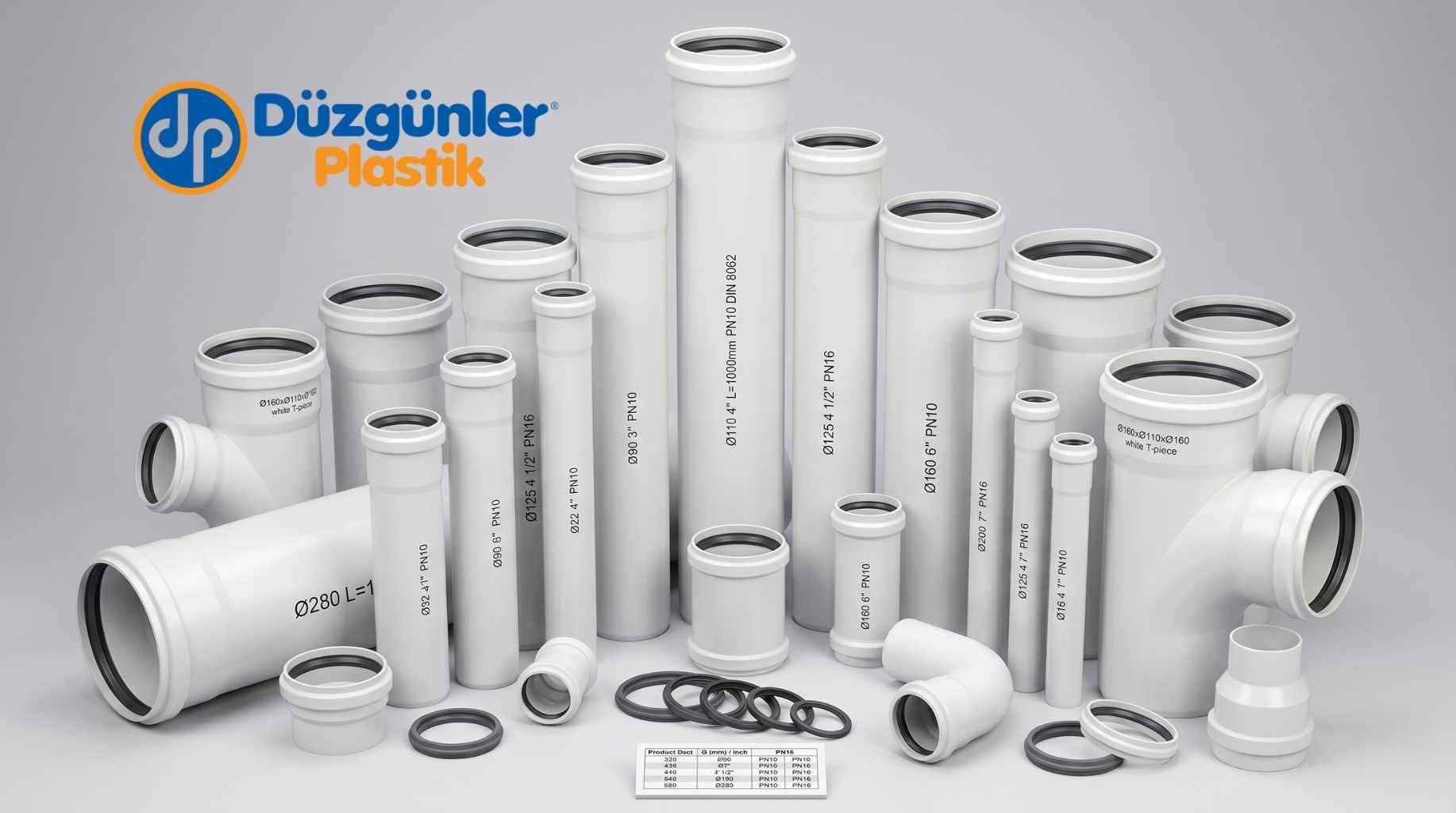
A clean water pipe is a high-pressure, chemical-resistant piping system used to safely transport drinking water, utility water, and process water from source to end-user. Duzgunler Plastik's U-PVC pressurized clean water pipes are produced with pressure ratings of 4 to 16 Atm, serving applications from municipal infrastructure to industrial facilities.
Clean water pipes are the most critical link in delivering safe drinking water from its source to the consumer. A low-quality or incorrectly chosen pipe can cause water leaks, contamination risks, and high maintenance costs. This makes the correct material and standard selection essential.
Duzgunler Plastik's U-PVC pressurized clean water pipes are produced in compliance with TS and ISO quality certificates, offering long-lasting, trouble-free performance with high resistance to UV radiation and chemicals.
There are several types of clean water pipes available on the market. Choosing the right one requires considering the intended use, pressure requirements, and installation conditions.
Socket-joint (pass-through socket) clean water pipes offer fast and secure installation thanks to their specially designed gasket connection system. They are widely preferred in large-diameter infrastructure lines and municipal water networks. The sealing performance is maximized with the O-ring gasket structure.
Solvent-weld socket clean water pipes are joined using a special solvent-based adhesive, forming a compact and strong connection. They are particularly preferred in confined-space indoor installations and industrial applications. When applied correctly, the joint becomes as strong as the pipe itself.
Gooseneck (camel neck) clean water pipes are specially angled pipe sections used at points where the line direction must change. Their curved structure allows them to navigate obstacles, making them indispensable in mountainous terrain and complex infrastructure projects.
The key technical specifications of Duzgunler Plastik's U-PVC pressurized clean water pipes are listed in the table below:
|
Property |
Value |
Details |
|
Material |
U-PVC |
Unplasticized polyvinyl chloride |
|
Pressure Rating |
4 – 16 Atm |
Varies by pipe class |
|
Quality Standard |
TS & ISO Certified |
TS 274 / ISO 1452 |
|
UV Resistance |
High |
Suitable for outdoor applications |
|
Chemical Resistance |
High |
Not affected by chlorine or mild acids |
|
Installation Method |
Socket / Solvent Weld |
Selectable per project |
U-PVC pressurized clean water pipes are used across a wide range of projects, from urban infrastructure to industrial facilities:
Municipal drinking water distribution networks
Agricultural irrigation systems and farm water supply
Industrial facilities – process water transport lines
Construction project infrastructure piping systems
Swimming pools and recreational facility water distribution
Industrial cooling and heating circuit lines
Both pipe types are safe for clean water transport, but there are important differences depending on the application conditions.
|
Criteria |
U-PVC Clean Water Pipe |
HDPE PE100 Pipe |
|
Flexibility |
Rigid, stiff structure |
Flexible, bendable |
|
Pressure Rating |
4 – 16 Atm |
6.3 – 25 Bar |
|
Installation Ease |
Easy (socket/solvent weld) |
Welding machine required |
|
Cost |
More economical |
Slightly higher |
|
Chemical Resistance |
High |
Very high |
|
Best Use |
Networks, infrastructure |
Drilling, rough terrain, irrigation |
For short-distance, fixed lines where cost efficiency matters, U-PVC is the right choice. For seismic zones or challenging terrain, HDPE is more suitable. Duzgunler Plastik manufactures both product groups in full compliance with applicable standards.
With deep industry experience since 1975, Duzgunler Plastik operates from a 30,000 m² closed production facility in Konya 3rd Organized Industrial Zone and ranks among Turkey's leading pipe manufacturers.
Production compliant with ISO 9001:2015 quality management system
TS and ISO certified product assurance
Production lines designed in-house by the R&D department
Wide product range: socket-joint, solvent-weld, and gooseneck variants
Pressure classes from 4 to 16 Atm
UV and chemical-resistant material
A clean water pipe is used to safely transport drinking water, utility water, and industrial process water through underground or surface piping systems. Its UV and chemical-resistant structure ensures trouble-free service for many years.
Duzgunler Plastik's U-PVC pressurized clean water pipes are produced in pressure classes ranging from 4 to 16 Atm. Simply select the appropriate pipe class based on your project's pressure requirements.
U-PVC pressurized clean water pipes are generally produced in diameters ranging from 20 mm to 315 mm. Commonly used sizes include 32 mm, 50 mm, 63 mm, 110 mm, and 160 mm.
Socket-joint U-PVC pressurized clean water pipes are generally preferred for underground applications. Their gasket connection system offers resistance to ground movement. If greater flexibility is needed, HDPE PE100 pipes can also be considered as a suitable alternative.
Clean water pipes are pressure-rated, leak-proof, and made from food-grade material. Drainage pipes are non-pressurized, designed for gravity flow, and calculated with different diameter and slope parameters. The two pipe types must never be used interchangeably.
High-quality U-PVC pipes can last 50 years or more under correct installation and appropriate operating conditions. Duzgunler Plastik's ISO 9001-certified products are manufactured for long-term performance.
U-PVC pressurized clean water pipes are typically produced in grey or dark grey. Some manufacturers also offer blue or light-colored pipes. Color does not determine material safety or quality; compliance with TS and ISO standards is what matters.
No, they are not. Plumbing pipe is a general term covering indoor hot and cold water distribution and can come in various materials (PPR, copper, CPVC). Clean water pipe specifically refers to the piping system used in drinking and utility water lines, particularly in high-pressure outdoor main line applications.
Standard U-PVC pipes are suitable for cold water applications only. For hot water lines, CPVC (chlorinated PVC) or PPR pipes should be used. Always check the temperature rating on the product datasheet before selection.
Duzgunler Plastik's U-PVC pressurized clean water pipes are produced in compliance with TS 274 and ISO 1452 standards, and the quality management system is certified under ISO 9001:2015.
This content has been prepared with the technical knowledge of Duzgunler Plastik, a manufacturer with over 50 years of experience in the plastic pipe industry, and with contributions from its R&D department. The content was created with reference to TS 274, ISO 1452, and ISO 9001:2015 standards. For further technical information, you may visit the Turkish Standards Institution (TSE) website at tse.org.tr.
For more information about our products and production processes, please contact us.
For more content, please visit our blog.
© 2025 DÜZGÜNLER PLASTIK | All Rights Reserved.


