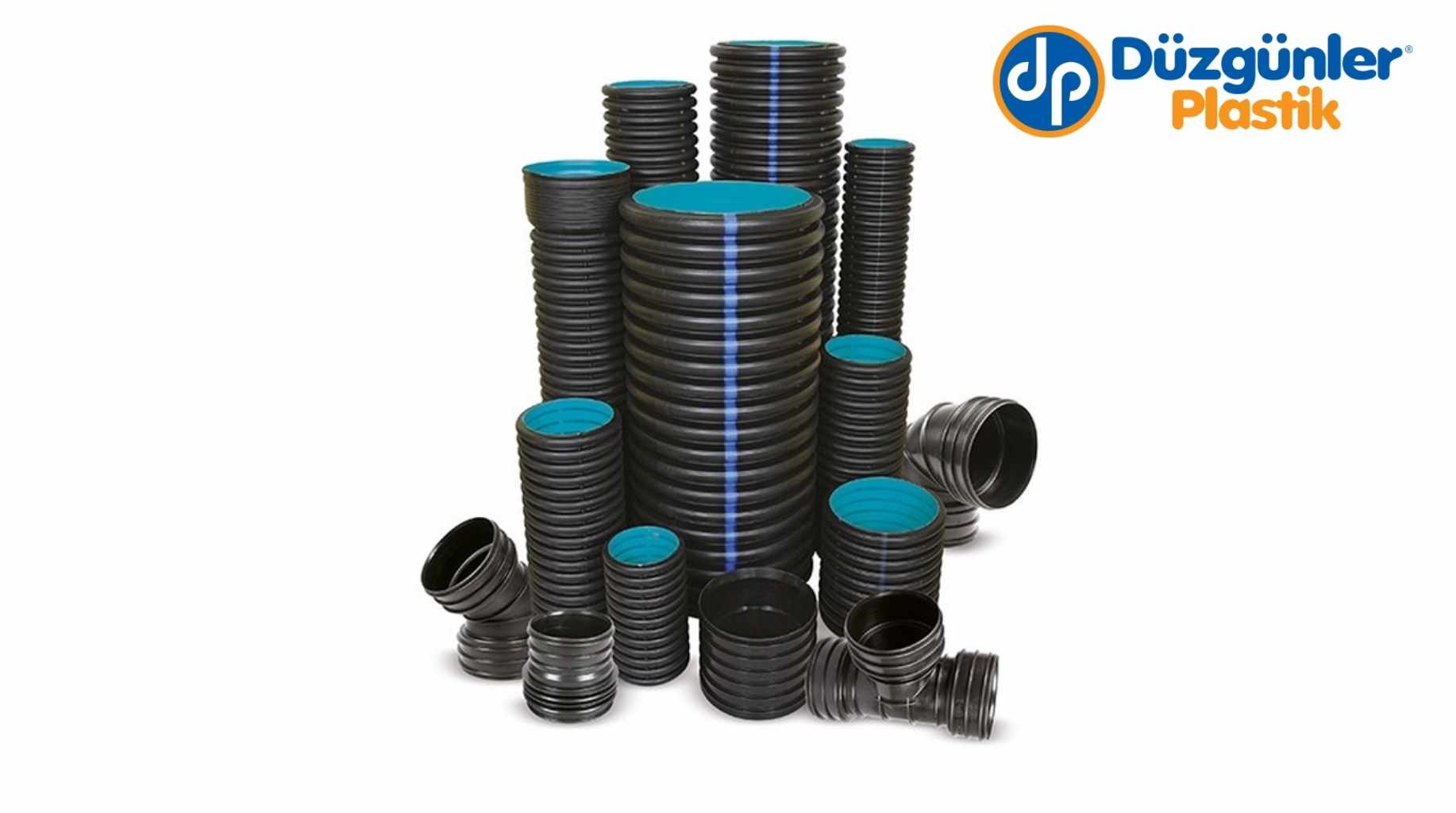
The environmental case for corrugated pipes rests on four points: gasketed joints stop wastewater escaping into the soil, the material does not corrode so the line serves for decades without replacement, the low weight cuts fuel used in transport and installation, and at end of life the HDPE can be recycled.
All four depend on choosing the right class and burying the pipe correctly. Below is the reason behind each point and what to watch for on site.
A corrugated pipe is a double-wall plastic pipe: the outer wall is profiled to carry soil and traffic load, the smooth inner wall keeps flow efficient. Common applications:
Domestic and industrial wastewater lines
Rainwater drainage and surface water collection
Cable protection ducts in road, industrial and residential infrastructure
The double-wall structure delivers stiffness without adding material, so the same load capacity is achieved with less plastic.
This structured-wall family is defined under EN 13476 with SN4 and SN8 ring stiffness classes. Sector data on plastic pipe systems is published by TEPPFA.
A gasketed socket joint works both ways. First, it stops wastewater escaping through the joints into soil and groundwater. Second, it stops groundwater infiltrating the line — infiltrated clean water adds unnecessary flow at the treatment plant and wastes pumping and treatment energy.
HDPE does not corrode. The hydrogen sulphide driven acid attack seen in concrete sewers does not affect a corrugated pipe. European standards assess structured-wall systems against a 50-year design life, which means fewer replacement excavations, less demolition waste and less new material produced.
HDPE is less dense than water, and a corrugated pipe is markedly lighter than a concrete equivalent of the same diameter. That converts into savings in three places: more metres per truck, smaller lifting equipment on site, and fewer machine hours because installation is faster.
Yes. HDPE is a thermoplastic and can be remelted and reprocessed. A line that reaches the end of its service life can be lifted and sent into recovery. The material is also inert and releases no heavy metals or protective chemicals into the soil.
The inner wall of a corrugated pipe is smooth. Low friction lets the same flow run at a shallower gradient and cuts pump energy where the line is pumped. Solids also build up less, so the line needs jetting and vacuum-truck cleaning less often — and every cleaning run costs vehicle time, water and energy.
Under ground settlement or seismic movement a rigid pipe cracks, while a flexible pipe deforms within limits and carries the load. Fewer broken lines means fewer repeat excavations and less contamination from leaks.
Both materials have their place. The differences that matter environmentally are these:
|
Criterion |
Corrugated Pipe (HDPE) |
Concrete Pipe |
|---|---|---|
|
Weight and haulage |
Light; fewer trips and less fuel |
Heavy; more trips and craneage |
|
Joint tightness |
Sealed by gasketed socket |
Depends on joint workmanship |
|
Chemical resistance |
Unaffected by sewer acids |
Exposed to sulphuric acid attack |
|
Ground movement |
Flexes; low fracture risk |
Rigid; higher cracking risk |
|
End of life |
Recyclable as HDPE |
Usually downcycled as fill or aggregate |
|
Raw material |
Fossil-based polymer |
Mineral-based |
The environmental performance of a corrugated pipe depends on installation quality. Six rules decide the outcome:
Choose the SN class for burial depth and traffic load; a pedestrian area and a heavy goods road do not need the same class.
Clean the gasket and socket faces before assembly; sand and mud break the seal.
Bed and compact the side fill as the design requires; in a flexible pipe the soil-pipe interaction carries the load.
Do not leave pipes in direct sunlight on site for long periods.
Run a tightness test before commissioning the line.
Use fittings, couplers and gaskets from the same system.
Düzgünler Plastik produces its corrugated pipes from HDPE raw material using three-layer Triplex extrusion technology. SN4 and SN8 class options cover a wide range, from domestic and industrial wastewater to rainwater drainage and cable protection. The gasketed joint system speeds up installation while securing tightness at every connection.
Manufacturing in Konya since 1975, the company designs the machinery on its production line in-house through its R&D department. That keeps product development and production under the same roof.
|
From the Field A point utility operators raise repeatedly: leaking old lines do not only create pollution — they also pull groundwater into the sewer and inflate the flow arriving at the treatment plant. Joint tightness is therefore not a detail of finish but an energy and environmental issue. |
In use and at end of life it has strong advantages: tightness, long life and recyclability. Its raw material, however, is a fossil-based polymer. A balanced view assesses the product across its whole service life rather than in isolation.
SN states ring stiffness. SN8 is stiffer and is chosen for deeper burial and heavier traffic loads. The class should follow the project calculation, not habit.
European standards assess these systems against a 50-year design life. Actual service life depends on material quality, burial conditions and the fluid carried.
No. Corrugated pipes are for non-pressure wastewater, rainwater and cable protection. Pressurised clean water needs HDPE PE100 or U-PVC pressure pipe systems.
Clean, separated HDPE can enter the plastics recovery stream. Mixed or heavily contaminated material recycles poorly, so separation during removal matters.
A double-wall plastic pipe with a profiled outer wall and a smooth inner wall, used for wastewater, drainage and cable protection.
Most commonly high-density polyethylene (HDPE); polypropylene versions also exist.
Perforated corrugated pipe is used for drainage; the unperforated type is for closed wastewater and stormwater lines.
Six metres is the common standard length; other lengths exist depending on diameter and manufacturer.
Not if the correct SN class is chosen and the side fill is properly compacted; most failures trace back to backfill errors.
This article was prepared by the technical team at Düzgünler Plastik, a plastic pipe manufacturer since 1975 that designs its own production machinery in-house. For background on the material, see Wikipedia – HDPE.
For more information about our products and production processes, please contact us.
For more content, please visit our blog.
© 2025 DÜZGÜNLER PLASTIK | All Rights Reserved.


