
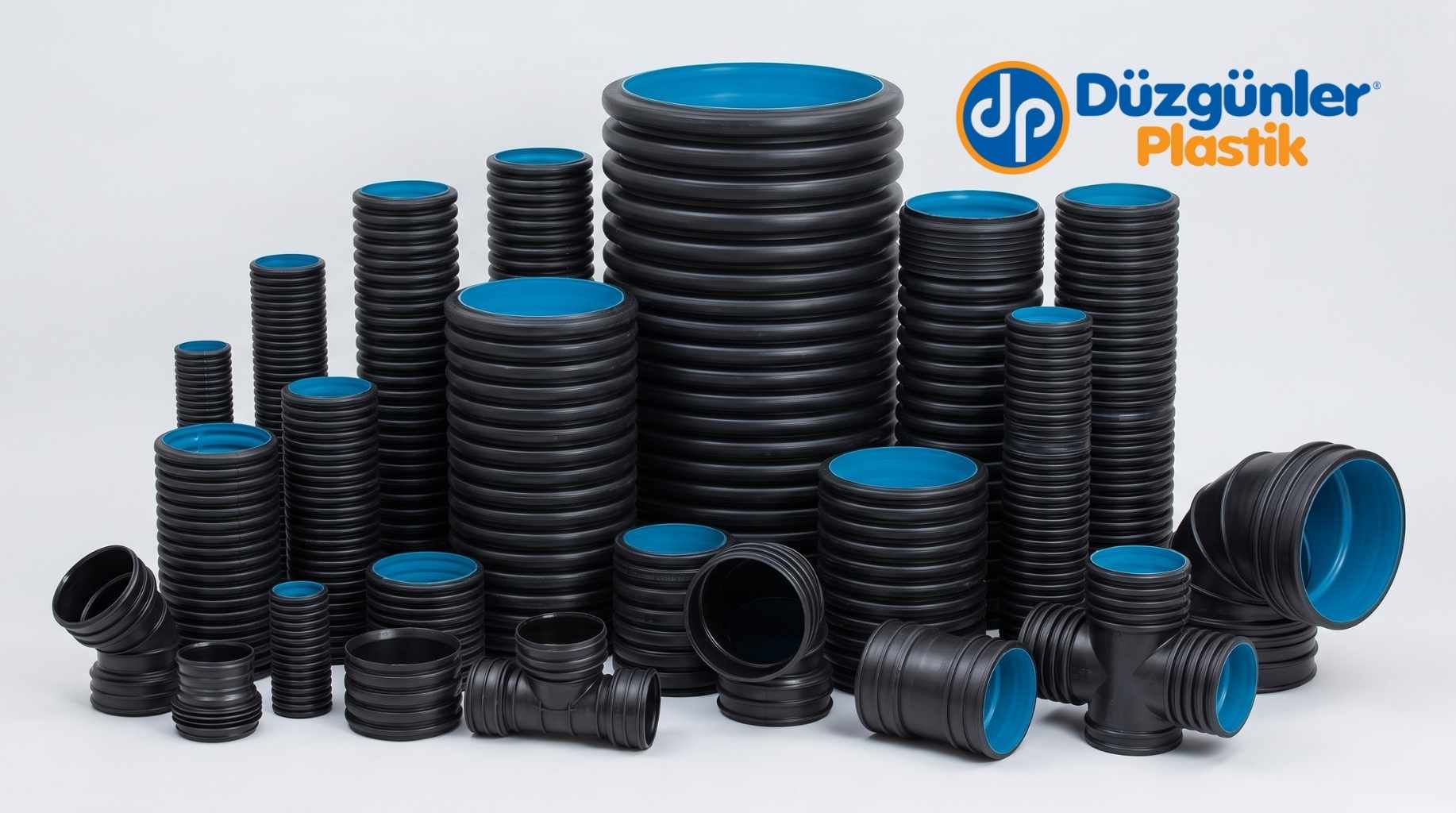
Double Wall Corrugated Pipe: Diameters, Applications
Double Wall Corrugated Pipe: Diameters, Applications & Selection Guide
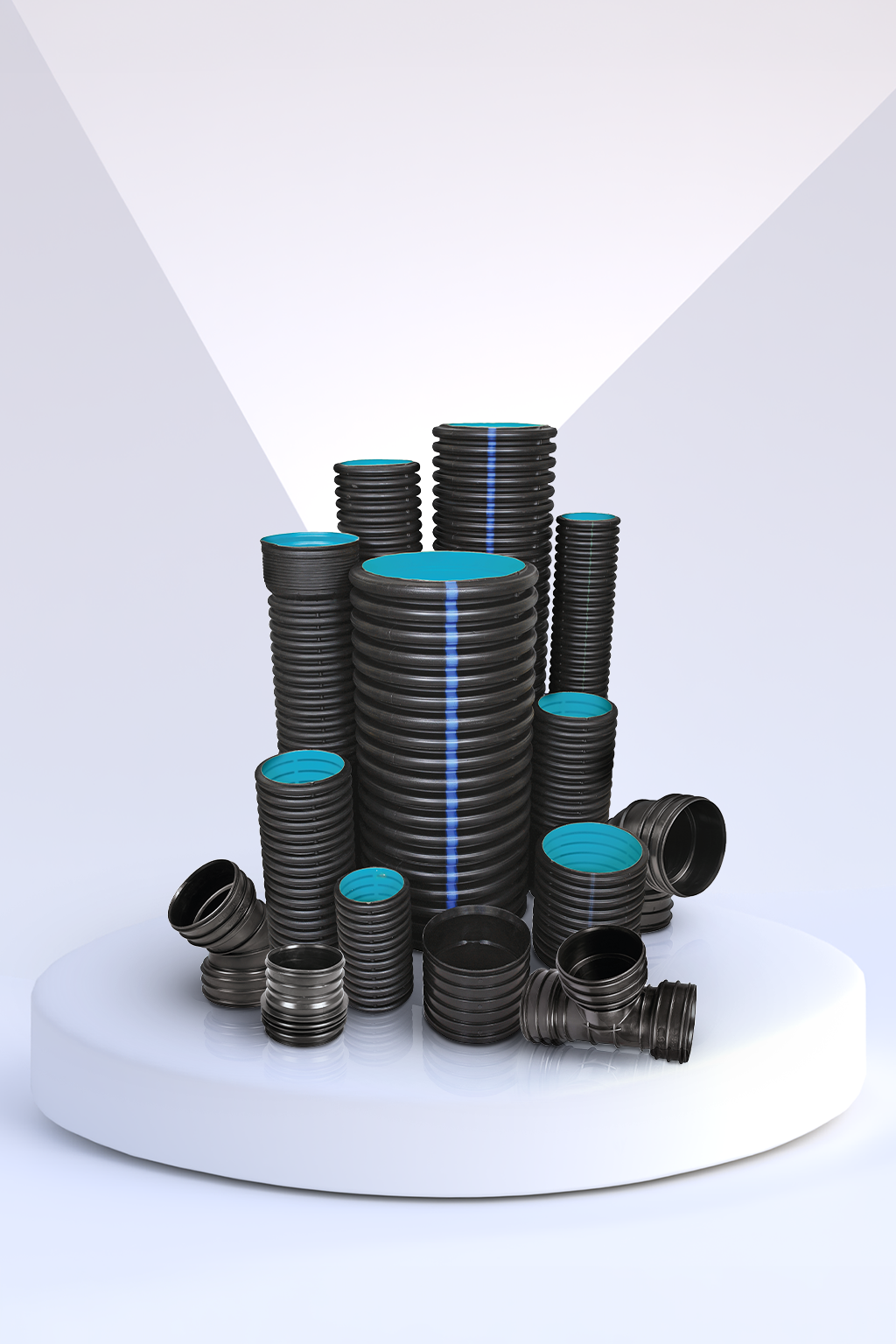
A double wall corrugated pipe (DWC pipe) is an HDPE-based drainage and infrastructure pipe with a corrugated outer wall for mechanical strength and a smooth inner wall for maximum flow capacity; it is the standard solution for sewage, stormwater drainage, and cable protection. Düzgünler Plastik manufactures EN 13476-certified double wall corrugated pipes in SN4 and SN8 ring stiffness classes, from DN 100 to DN 1000, using proprietary Triplex production technology.
What Is a Double Wall Corrugated Pipe and How Is It Made?
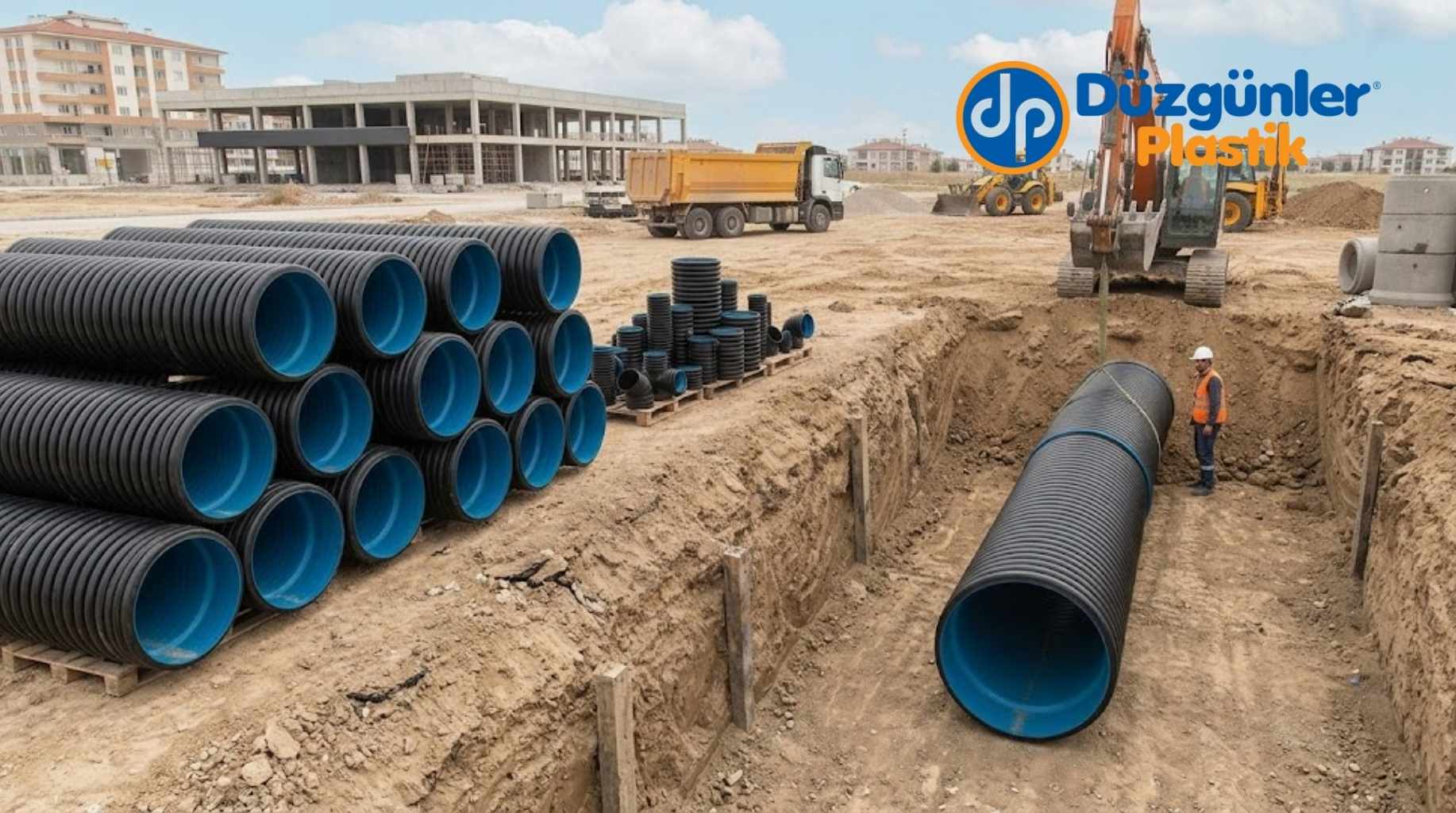
A double-wall corrugated (DWC) pipe is a twin-wall plastic pipe produced from High-Density Polyethylene (HDPE). The corrugated outer profile provides structural resistance against soil loads and vehicle traffic, while the smooth inner surface minimizes flow resistance and self-cleansing velocity — a critical combination for gravity drainage systems.
Düzgünler Plastik's Triplex technology co-extrudes three layers — corrugated outer skin, foam intermediate layer, and smooth inner liner — in a single process. This results in a pipe that is lighter, stiffer, and more cost-efficient per linear meter than conventional single-layer pipes.
Key Structural Features of Corrugated HDPE Pipes
-
Outer wall: Corrugated profile — resists soil pressure and point loads
-
Intermediate layer (Triplex): Foamed structure — weight reduction with added ring stiffness
-
Inner wall: Smooth and clean — low Manning coefficient, high hydraulic efficiency
-
Joint system: EPDM rubber seal — fast, leak-proof socket connection
-
Raw material: Virgin HDPE — chemical and UV resistance, 50+ year design life
SN4 vs SN8: Which Ring Stiffness Class Do You Need?
Ring stiffness (SN) measures a pipe's resistance to external soil pressure, per EN 13476. SN4 = 4 kN/m²; SN8 = 8 kN/m².
|
Criterion |
SN4 |
SN8 |
|---|---|---|
|
Ring Stiffness |
4 kN/m² |
8 kN/m² |
|
Recommended Depth |
0–4 m |
2–8 m and deeper |
|
Traffic Loading |
Light / pedestrian |
Heavy / vehicle traffic |
|
Typical Use |
Garden drainage, irrigation |
Road sub-base, urban infrastructure |
|
Pipe Weight |
Lighter |
Heavier |
|
Cost Level |
Economical |
Medium–high |
|
EN 13476 Certified |
Yes |
Yes |
Rule of thumb: Choose SN8 for road sub-base, car parks, and deep installations under vehicle loads. SN4 is adequate for garden, agricultural, or shallow residential drainage.
Corrugated Pipe Diameters: DN 100 to DN 1000
Düzgünler Plastik's corrugated pipe range covers a wide spectrum of nominal diameters to match any project scale.
|
Nominal Diameter (DN) |
Typical Application |
Class |
|---|---|---|
|
DN 100 (110 mm) |
Garden drainage, roof gutter connection |
SN4 / SN8 |
|
DN 160 (160 mm) |
Building outlet connection |
SN4 / SN8 |
|
DN 200 (200 mm) |
Street drainage, road-side discharge |
SN4 / SN8 |
|
DN 300 (300 mm) |
Neighbourhood collector line |
SN8 |
|
DN 400 (400 mm) |
Main drainage collector |
SN8 |
|
DN 600 (600 mm) |
Large-scale infrastructure |
SN8 |
|
DN 1000 (1000 mm) |
Urban trunk sewer/tunnel drainage |
SN8 |
Where Are Double Wall Corrugated Pipes Used?
Sewage and Wastewater Systems
The most common application is domestic and industrial wastewater conveyance. The smooth inner wall prevents solids build-up; HDPE provides superior resistance to aggressive chemicals including H2S and diluted acids found in municipal sewage.
Stormwater Drainage
In urban infrastructure, rapid removal of heavy rainfall is critical to prevent flooding. SN8 corrugated pipes under road surfaces and car parks bear heavy vehicle loads without deformation over decades of service.
Cable Protection
Red or orange color-coded corrugated pipes protect electrical, fiber optic, and telecom cables underground. The pipe's flexibility allows easy routing through bends and restricted spaces without special fittings.
Agricultural Drainage
For removing excess waterlogging from farmland, DN 100–DN 200 SN4 pipes deliver an economical and effective solution. HDPE's resistance to fertilizers and pesticides ensures the pipe remains unaffected throughout the growing season and beyond.
|
💬 Site Engineer — Municipal Drainage Project "We benchmarked several suppliers for DN 300 SN8 corrugated pipe. Düzgünler Plastik's Triplex pipes stood out in terms of seal quality and inner wall smoothness. Six years in, zero leakage incidents on that line." |
Frequently Asked Questions - FAQ
What is the difference between a corrugated pipe and a PVC pipe?
Corrugated HDPE pipes feature a double-wall structure providing significantly higher ring stiffness and soil load resistance than solid-wall PVC — making them the first choice for deep burial and heavy traffic applications. Standard PVC pipes are typically used for indoor drainage, potable water supply, and light-duty surface drainage. HDPE also offers superior chemical resistance and flexibility.
What diameter corrugated pipe do I need for a road drainage project?
For road sub-base drainage under vehicle traffic, a minimum of DN 200 SN8 is typically specified by civil engineers for lateral collectors. Main collector lines commonly require DN 300 to DN 600 SN8 depending on catchment area and flow calculations. Always follow local design standards and hydraulic sizing calculations.
How long does a corrugated HDPE pipe last?
EN 13476-certified HDPE corrugated pipes have a design life of 50 years or more under correct installation conditions. HDPE's resistance to UV radiation, chemicals, ground movement, and biological degradation is the primary reason for this exceptional service life.
How is a double wall corrugated pipe installed?
The EPDM rubber seal socket system makes installation straightforward: clean the spigot and socket ends, seat the EPDM ring in the groove, align the pipes, and push together axially. No adhesive or heat welding is required. A brief water pressure test at joints is recommended before backfilling. For deep installations, ensure proper sand bedding and compaction per EN 1610.
Can Düzgünler Plastik supply large-diameter corrugated pipe accessories?
Yes. Düzgünler Plastik supplies a full range of compatible accessories — couplings (manşon), bends, inspection chamber lids, and reducers — for the complete corrugated pipe range up to DN 1000. Single-source supply ensures system compatibility and simplified procurement.
People Also Ask (PAA)
What is the difference between SN4 and SN8 corrugated pipe?
SN8 has twice the ring stiffness of SN4 (8 kN/m² vs 4 kN/m²), making it suitable for deeper burial depths and heavier traffic loads. SN4 is adequate for shallow, light-duty drainage applications.
What does DN mean on a corrugated drainage pipe?
DN stands for Diameter Nominal — it is the standardized nominal inner diameter of the pipe in millimetres, per EN 13476. DN 160 = 160 mm nominal inner diameter.
Is corrugated HDPE pipe resistant to chemicals?
Yes. HDPE is highly resistant to a wide range of chemicals including diluted acids, alkalis, salts, and many solvents — making it suitable for both domestic sewage and industrial effluent drainage applications.
What is Triplex corrugated pipe technology?
Triplex is Düzgünler Plastik's proprietary three-layer co-extrusion process that combines a corrugated outer skin, a foamed intermediate layer, and a smooth inner liner in a single production pass — delivering higher ring stiffness at lower pipe weight compared to conventional two-layer corrugated pipes.
For more information about our products and production processes, please contact us.
For more content, please visit our blog.
Similar Blogs