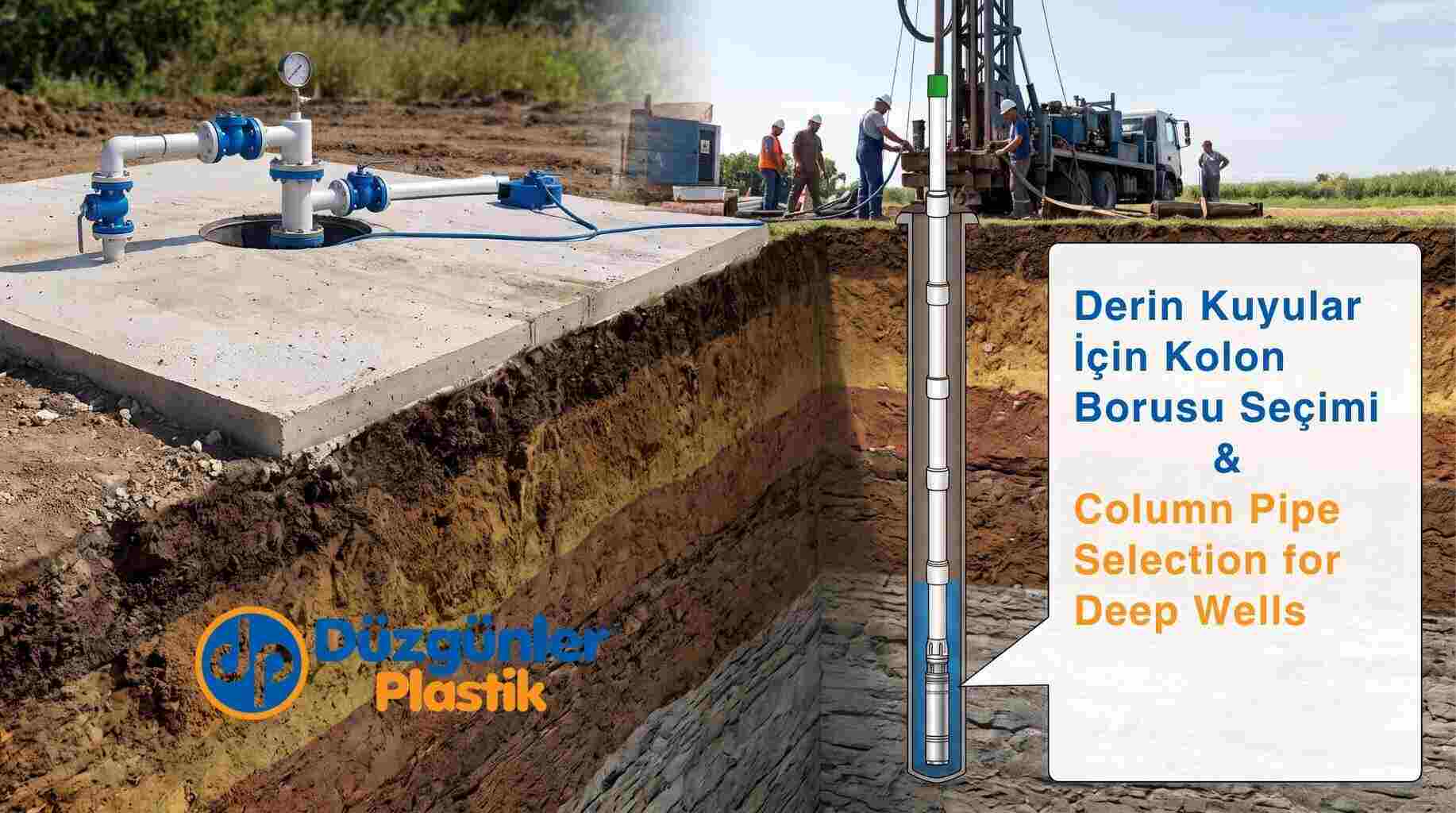
How to Choose a Column Pipe for Deep Wells?, The best column pipe for deep wells is a uPVC column pipe with a square thread system and an "O" ring seal, selected according to well depth and the load of the submersible pump. Düzgünler Plastik's DCP series — Medium Plus, Standard Plus, Heavy and Super Heavy — directly answers different depth and pressure requirements.
This guide explains what a column pipe does in a deep well, which model fits your depth, and the key steps of a safe installation, based on the field experience of Düzgünler Plastik.
A column pipe is the vertical pipe line that carries the submersible pump lowered into a deep well and delivers the pumped water to the surface. As the well gets deeper, both the static water load and the pump weight increase, so the tensile strength and the sealing of the column pipe become critical.
In deep wells, a column pipe has three core duties:
Safely carrying the submersible pump and the water column inside the line
Sealing every joint to prevent pressure loss
Resisting vibration and torque without loosening over long service periods
Düzgünler Plastik's square thread system combined with the "O" ring at the end of the thread unites these three duties in a single joint design. The "O" ring blocks abrasive particles such as sand and silt, reduces friction, and increases overall system efficiency by 10% to 30%.
Model selection depends on well depth, pump power and the total load on the line. Medium Plus and Standard Plus cover shallow and medium depths; Heavy is designed for deep boreholes, while Super Heavy is engineered for extreme loads and high-pressure applications.
|
Model |
Application |
Key Feature |
Load Capacity |
|
DCP Medium Plus |
Shallow to medium depth |
Low friction, easy assembly |
Standard |
|
DCP Standard Plus |
Medium depth |
Balance of economy and strength |
Medium |
|
DCP Heavy |
Deep boreholes |
Reinforced body structure |
High |
|
DCP Super Heavy |
Very deep wells, intensive pumping |
Thick wall, extra strength |
Maximum |
All four models feature externally square-threaded male ends on both sides and connect with couplers. This allows the pipes to be assembled and disassembled easily at any depth, so the line can be pulled quickly during pump maintenance.
Short answer: a uPVC column pipe does not corrode, weighs far less than a metal pipe, and its smooth inner surface keeps pressure loss low. In deep wells, these three differences translate directly into efficiency during both installation and operation.
Corrosion resistance: uPVC never rusts, so water quality and taste are not affected.
Light weight: transport and installation are completed faster with less labor.
Low friction coefficient: the smooth bore reduces the pump's energy consumption.
Chemical resistance: no decay or wear even in aggressive groundwater conditions.
Leak-proof joints: the square thread and "O" ring combination prevents vibration-related loosening.
The only clear advantage of metal pipes is very high-temperature service, which practically never occurs in drinking water or irrigation wells. For most deep well applications, uPVC column pipes deliver a more efficient result.
Correct installation determines the service life of a column pipe. The steps below form the basic field checklist for deep wells:
Select the correct DCP model according to well depth and pump load.
Clean the threaded areas before assembly; leave no sand or silt residue.
Check at every joint that the "O" ring sits correctly in its groove.
Tighten the coupler joints in axial alignment without over-torquing.
Fix the pump cable to the pipe line at regular intervals.
Lower the line steadily without scraping the pipe against the wellhead.
When these steps are followed, the risk of loosening and leakage at the joints is minimized, and the line can be pulled and reinstalled many times for pump maintenance.
Depending on the model, uPVC column pipes are safely used in deep boreholes. As depth increases, choose the high-strength Heavy or Super Heavy series; for the exact model, request technical support with your well depth and pump data.
A casing pipe forms the wall of the borehole, while a column pipe is the line lowered inside the well that carries the pump and delivers the water. The two products work together, but their functions are completely different.
A square thread spreads the load over a wider contact surface between the threads. This makes the joint easy to assemble and disassemble at any depth and highly resistant to loosening under vibration.
Yes. The "O" ring at the end of the thread blocks abrasives such as sand and silt, lowers friction, and improves system efficiency by 10% to 30%. It also eliminates the risk of vibration-related loosening at the joints.
All DCP series column pipes are manufactured under the ISO 9001 quality management system and pass laboratory testing. Düzgünler Plastik is the first company in Turkey to produce Submersible Pump uPVC Column Pipes.
Evaluate the pump power, the well depth and the weight of the water column together. Based on these three inputs, the suitable series is selected from DCP Medium Plus up to Super Heavy.
Yes. When the correct series is selected, a uPVC column pipe safely carries the submersible pump and the water column. As the load increases, the thick-walled Heavy and Super Heavy series are used.
The square thread and "O" ring combination is designed to prevent vibration-related loosening. When installation rules are followed, the joints keep their original tightness for a long service life.
Düzgünler Plastik manufactures column pipes at its facilities in the Konya 3rd Organized Industrial Zone and supplies both the Turkish market and international export markets.
For more information about our products and production processes, please contact us.
For more content, please visit our blog.
© 2025 DÜZGÜNLER PLASTIK | All Rights Reserved.


