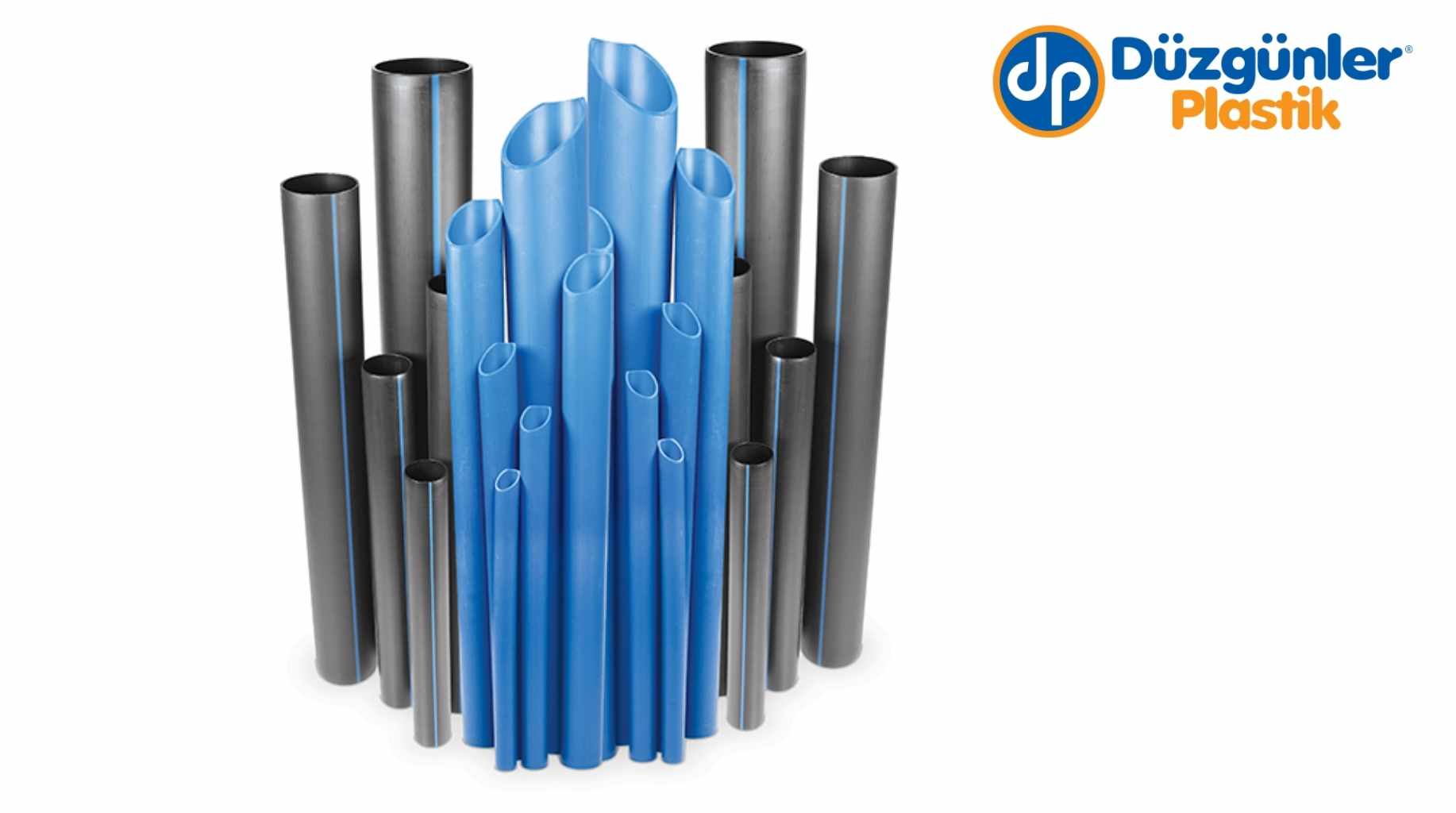
PE100 pipes are preferred because they do not corrode, are lightweight and flexible, have a low friction coefficient, and are joined with leak-free fusion connections. Together, these properties give a correctly specified PE100 line a service life of at least 50 years at 20 °C.
PE100 Pipes are the class of high-density polyethylene (HDPE) pipe with a Minimum Required Strength (MRS) of 10.0 MPa. The “100” comes from multiplying that strength by ten under ISO 12162; by comparison, PE80 pipe has an MRS of 8.0 MPa.
PE100 is regarded as the third generation of pipe-grade polyethylene. It balances three key properties at once: long-term strength, resistance to slow crack growth (SCG), and resistance to rapid crack propagation (RCP).
Düzgünler Plastik HDPE PE100 pipes are produced in accordance with the TS EN 12201-2 standard and the ISO 9001:2015 quality management system. They are offered in both coil and straight-length options for practical installation of long lines.
The main reasons PE100 pipes are so widely chosen are:
Corrosion resistance: Unlike metal pipe, PE100 does not rust or rot and resists many chemicals.
Long service life: The standard design assumes at least a 50-year service life at 20 °C, and this can be even longer under suitable conditions.
Leak-free joints: With butt fusion and electrofusion, the pipe and fitting become a single piece, largely eliminating the risk of joint leakage.
Light weight and easy installation: Far lighter than metal pipe; transport and installation are fast, and coil form lets long lines be laid with few joints.
Low friction and energy savings: A smooth inner wall gives a low friction coefficient — higher flow at the same diameter and lower pump energy.
Resistance to ground movement and impact: Its flexible structure withstands settlement, freezing, and impact.
The low friction coefficient and leak-free structure of PE100 make it suitable for many lines that carry water under pressure. Its main applications are:
Drinking water and clean water networks
Agricultural irrigation lines (HDPE irrigation pipe)
Pressurized water transmission and infrastructure lines
Industrial liquid and fluid transport systems
PE100 pipes are produced across a wide diameter range; 90 mm, 110 mm, 160 mm, and 200 mm are among the most common field sizes. The pressure class is set by the SDR (the ratio of outside diameter to wall thickness).
As the SDR value drops, wall thickness — and therefore pressure rating (PN) — increases. For example, PE100 SDR17 corresponds to roughly PN10, while SDR11 offers a higher pressure class. High-pressure lines use a lower SDR product.
The right choice depends on the line’s operating pressure, working temperature, and the fluid being carried. Above 20 °C, pressure values must be de-rated in the calculation.
In water and irrigation lines, the two options most often compared are HDPE PE100 and metal (galvanized/steel) pipe. The table below summarizes the key differences:
|
Criterion |
HDPE PE100 |
Metal (Galvanized/Steel) |
|---|---|---|
|
Corrosion resistance |
Rust-free, does not rot |
Rusts / corrodes over time |
|
Weight |
Light |
Heavy |
|
Joints |
Leak-free fusion |
Threaded/welded, leak risk |
|
Expected life |
50 years and above |
Varies by environment, often shorter |
|
Flexibility |
Flexible, coil form |
Rigid |
|
Installation |
Fast, low labor |
More labor |
Metal pipe may still be preferred in special applications requiring very high temperature or specific mechanical loads. For drinking water, clean water, and agricultural irrigation, however, PE100 stands out in durability, sealing, and total cost.
|
💬 Frequently Discussed in Forums “Can I join PE100 pipe with threaded/mechanical fittings?” Mechanical fittings can be used for short or low-pressure transitions; for a permanent, fully leak-free line, butt fusion or electrofusion is recommended. The joining method should be chosen according to the line pressure and expected service life. |
The main difference is strength. PE100 has a Minimum Required Strength of 10.0 MPa, while PE80 is 8.0 MPa. As a result, PE100 carries higher pressure at the same wall thickness, or offers a thinner wall (larger bore) for the same pressure.
Yes. PE100 pipes produced to the TS EN 12201-2 standard are designed for drinking water and clean water lines. Their smooth inner surface allows water to be transported safely and efficiently.
PE100 lines are calculated for a service life of at least 50 years at 20 °C and design pressure. When operating temperature and pressure are kept within the intended values, that life can be even longer.
The two most common methods are butt fusion and electrofusion. Both fuse the pipe and fitting into a leak-free, single-piece line. Mechanical fittings may also be used at smaller diameters.
Coil PE100 pipe is generally made in small and medium diameters and lets long lines be laid quickly with few joints. Straight lengths are preferred at large diameters and where a rigid line is required.
A PE100 pipe is a pressure pipe made from high-density polyethylene (HDPE) with a Minimum Required Strength of 10.0 MPa.
PE100 pipes are produced across a wide diameter range; 90 mm, 110 mm, 160 mm, and 200 mm are among the most common field sizes.
It describes a PE100 pipe made with a low SDR and thick wall so it can withstand an operating pressure of about 16 bar.
Düzgünler Plastik ships nationwide from its Konya-based production facilities. For PE100 pipe pricing and delivery details, please contact the company.
This content was prepared by the technical team of Düzgünler Plastik — active in plastic pipe production since 1975 — based on field experience and current EN/ISO standards. From its facilities in Konya, the company manufactures a broad product range including column pipes, deep-well pipes, and HDPE PE100 pipes.
Sources:
For more information about our products and production processes, please contact us.
For more content, please visit our blog.
© 2025 DÜZGÜNLER PLASTIK | All Rights Reserved.


