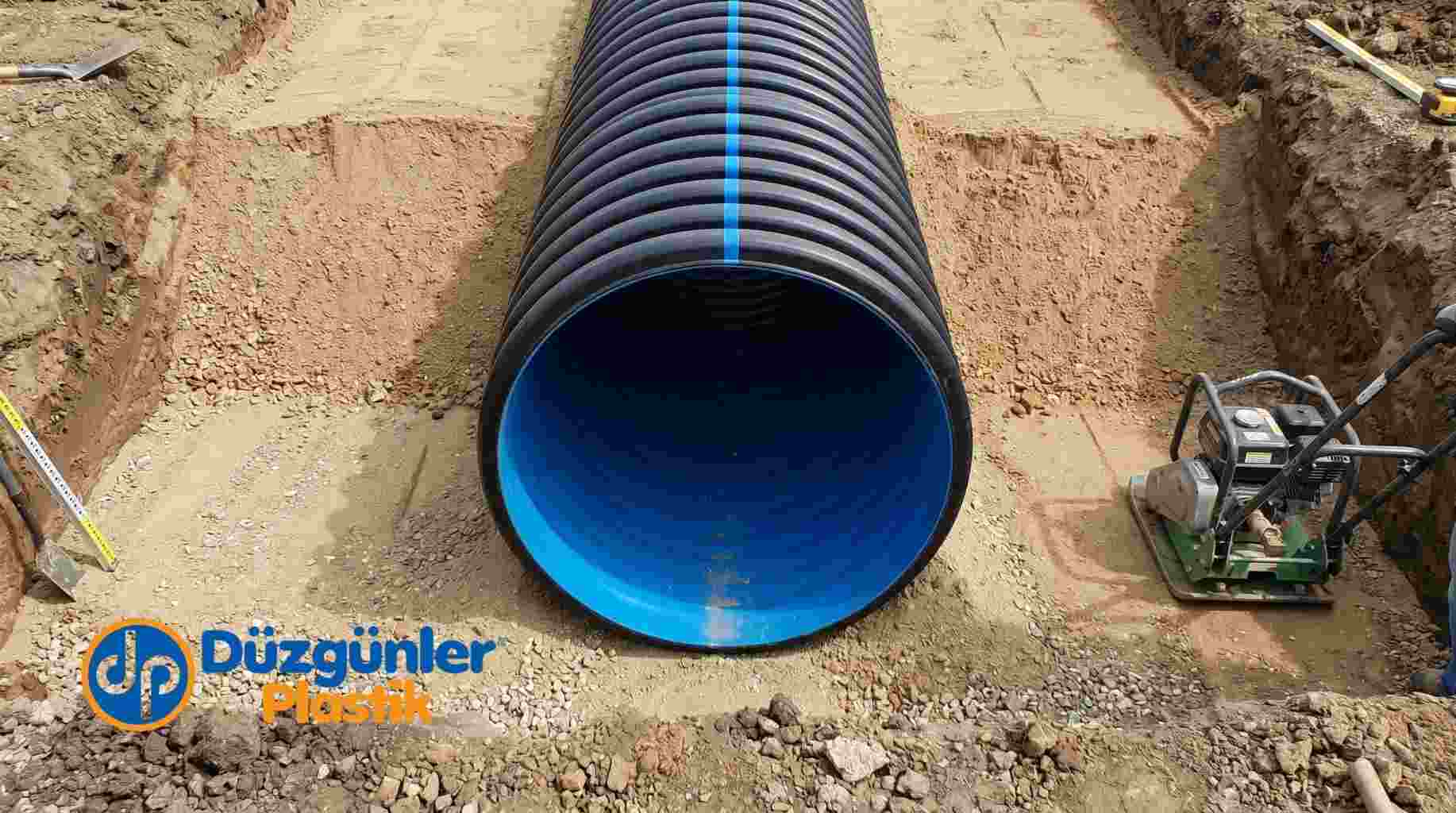
Due to their flexible (viscoelastic) nature, corrugated pipes cannot bear static and dynamic loads on their own. The primary element preventing pipe deformation, crushing, and structural failure is the surrounding proper bedding and compacted backfill material. Backed by half a century of industrial R&D power, Düzgünler Plastik explains the mechanical boundaries of pipe-soil interaction and global engineering protocols to ensure zero-error execution in infrastructure projects.
In modern subterranean infrastructure, high-density polyethylene (HDPE) lines are the global standard for domestic wastewater, rainwater drainage, and cable protection systems. However, a catastrophic error frequently observed on construction sites is treating flexible (HDPE) pipes and rigid (concrete) pipes as structurally identical.
With a 51-year institutional heritage established in 1975, and featuring an elite in-house R&D department that designs its own production machinery, Düzgünler Plastik stands as the uncompromising pioneer of the plastic pipe industry. This half-century of engineering expertise proves that the field performance of an HDPE corrugated pipe is completely dependent on the precision of the surrounding soil engineering.
Corrugated pipe bedding refers to the granular material layer placed at the bottom of the trench before the pipe is laid. Backfill encompasses the soil layers that envelope the sides (haunching) and top of the pipe, which must be compacted in structured stages.
While concrete pipes resist vertical structural loads through their rigid wall mass, HDPE corrugated pipes leverage their flexibility to transfer vertical loads horizontally into the adjacent compacted soil. This means the structural system is entirely a "Pipe + Compacted Soil" partnership. If the sidefill is not properly compacted, the pipe will attempt to deflect laterally under load; lacking lateral soil support, it will suffer elliptical deformation and eventual structural collapse.
The critical challenge that engineers and project managers globally deliberate on technical forums points directly to this installation phase. The following quote extracted from a global infrastructure forum explicitly illustrates the real-world consequence of improper backfilling:
"We utilized SN8 corrugated pipes on our project, yet we detected a 12% deflection after heavy vehicular traffic crossed the alignment. We initially suspected a manufacturing defect. However, upon excavating a cross-section of the trench, we discovered that the subcontractor had dumped the native, clay-heavy, and rocky excavated soil directly over the pipe without any vibratory backfill compaction. We learned the hard way that no matter how premium the pipe quality or how high its ring stiffness (SN) rating, the pipe cannot survive alone if the surrounding soil matrix is uncompacted."
To align with standards and rigorous international engineering codes, the following execution steps must be deployed:
Trench Width: The trench must be wide enough to leave at least 20 cm to 30 cm of clearance on both sides of the pipe outside diameter (OD) to allow compaction equipment to operate effectively.
Bedding Layer: A minimum of 10-15 cm of stone-free, non-cohesive granular material or crushed rock must be laid and leveled along the trench bed.
Haunching & Sidefill: Backfill material must be placed in uncompacted layers of maximum 15 cm on both sides of the pipe and compacted using hand tampers or light vibratory equipment to a minimum of 95% Standard Proctor density. No voids should remain under the pipe haunches.
Initial Backfill: The fill must extend at least 30 cm above the crown of the pipe using approved granular material before heavy vibratory rollers are permitted near the structural line.
Answer: Absolutely not. If the native trench excavation contains large stones, sharp rocks, or high clay content, it will damage the external corrugations and prevent uniform compaction. Backfill must consist of clean, specified granular materials.
Answer: SN (Stiffness Number) quantifies the ring stiffness of the pipe in $kN/m^2$. Düzgünler Plastik corrugated pipes are manufactured using advanced Triplex production technology in both SN4 and SN8 classes. SN4 is preferred for shallow, light-load applications, whereas SN8 is strictly mandatory for deep burials or areas subjected to traffic loads.
For more information about our products and production processes, please contact us.
For more content, please visit our blog.
© 2025 DÜZGÜNLER PLASTIK | All Rights Reserved.


