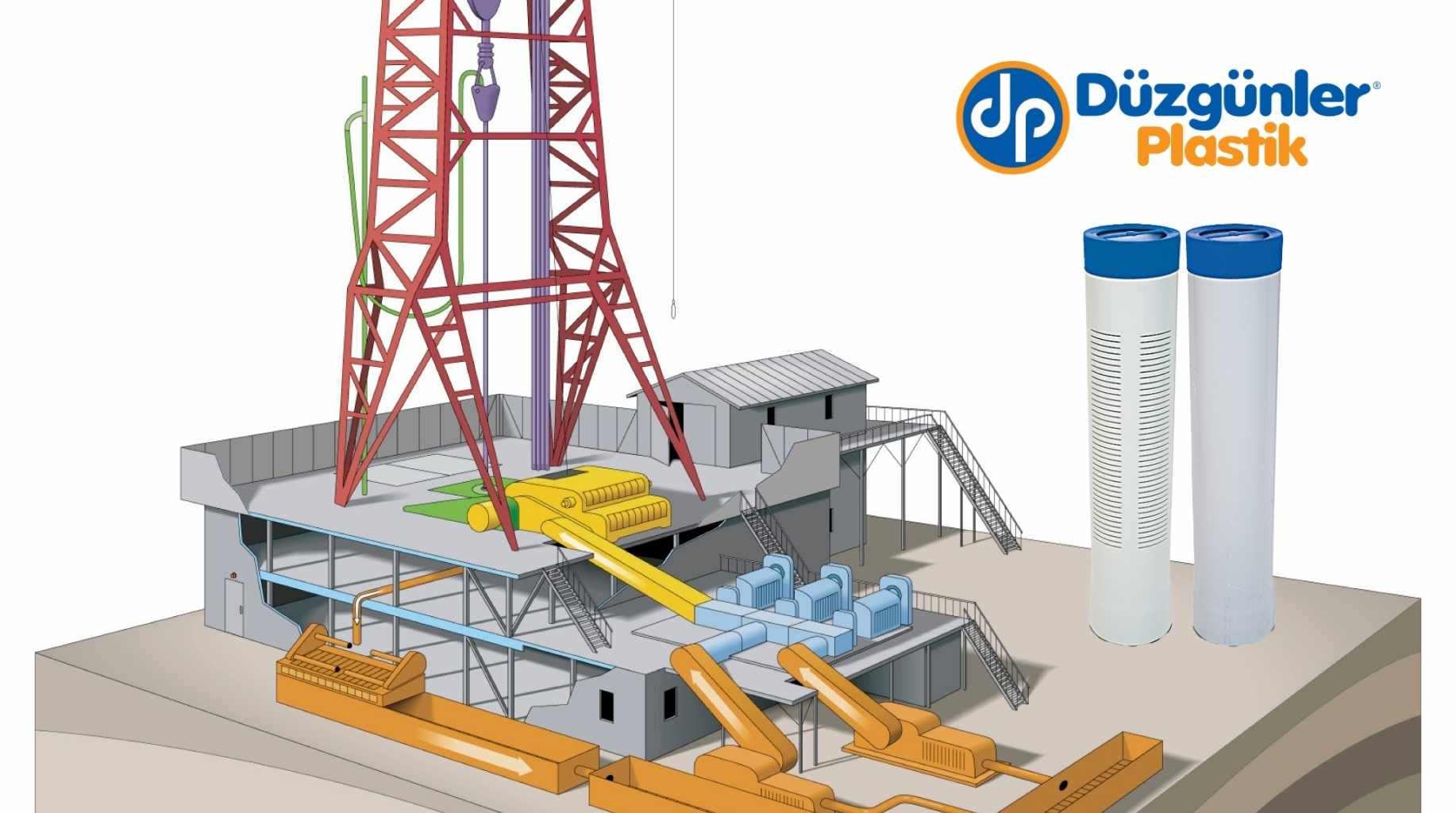
A U-PVC deep well pipe is a corrosion-resistant plastic casing installed inside a borehole to access underground water sources. Düzgünler Plastik's U-PVC deep well pipes are produced in compliance with TS 11794 standard and ISO 9001:2015 quality system, with depth-rated pressure classes for 100, 300, and 500-meter applications — guaranteeing safety and efficiency at every depth.
U-PVC (Unplasticised Polyvinyl Chloride) is the most widely specified plastic material for borehole applications because of its high rigidity, chemical resistance, and service longevity. The deep well pipes the borehole wall to prevent collapse and provides the passageway through which a submersible pump lifts water to the surface.
Core advantages of U-PVC deep well pipe over steel casing alternatives:
Zero corrosion: Steel casings corrode progressively depending on groundwater mineral content. U-PVC is chemically inert to acids, alkalis, and saline environments.
Lightweight: Approximately 5–6 times lighter than steel, significantly reducing transport, logistics, and on-site installation costs.
Long service life: Correctly rated U-PVC deep well pipe delivers 50+ years of service under standard groundwater conditions.
Potable water safe: U-PVC has no adverse effect on water quality, making it the preferred choice for drinking water boreholes.
At depths up to 100 meters, hydrostatic pressure is relatively modest. Düzgünler Plastik's 100-meter rated series is the economical choice for small-scale agricultural irrigation boreholes and residential water supply projects, offering practical handling and straightforward installation.
At 300 meters, the pressure exerted by the static water column is three times that of a 100-meter application. This requires greater wall thickness and connection strength. Düzgünler Plastik's 300-meter series is widely used in agricultural irrigation projects and small-to-medium-scale industrial water supply boreholes.
500 meters represents the most demanding depth class for U-PVC borehole casing. Hydrostatic pressure is extreme at this level; wall thickness and connection integrity must be engineering-calculated accordingly. Düzgünler Plastik's 500-meter series — available in both plain and slotted (screen) configurations — is specified for deep well exploration projects and large-scale industrial water supply boreholes.
These two pipe types serve different zones of the same borehole and are typically used together in the same installation:
Plain casing pipe: Installed in the non-water-bearing formations above the aquifer. Its function is structural — supporting the borehole wall and providing the pump column passageway. It does not allow water ingress.
Slotted screen pipe (süzgeçli): Installed at the depth interval corresponding to the water-bearing aquifer layer. The precision-cut slots allow water to enter while retaining fine sand and silt particles outside the casing string.
Correct placement of the right pipe type at the right depth directly determines borehole yield and long-term performance. Düzgünler Plastik's technical sales team works from drilling logs and hydrogeological data to determine the optimum casing design with the customer.
Founded in 1975 by Ekrem Düzgün, Düzgünler Plastik — now led by sons Ziya Düzgün and Kemal Düzgün — is one of Turkey's leading plastic pipe manufacturers. The company achieved a sector first by producing Submersible Pump U-PVC Column Pipes for the first time in Turkey, and has maintained technology leadership since by designing all production machinery in-house through its R&D department.
Technical performance points:
TS 11794 compliance and ISO 9001:2015 certification: Every production batch passes conformance testing against these standards.
Full resistance to decay, corrosion, and chemical attack: Chemically inert to groundwater chemistry and soil components.
Easy installation: Lightweight structure and standardized connection system minimize on-site installation time.
In-house R&D machine design: Production tolerances and quality consistency are continuously improved through this approach.
100,000 m² open and 30,000 m² closed production area: Enables project-specific delivery scheduling for large-volume borehole projects.
U-PVC (Unplasticised PVC) contains no plasticiser additives, which results in higher rigidity, superior chemical resistance, and greater pressure rating compared to standard plasticised PVC. This is precisely why U-PVC is the specified material for borehole casing applications. All Düzgünler Plastik deep well pipe products are manufactured exclusively from U-PVC material.
Diameter selection is governed by three parameters: the submersible pump's nominal diameter, target flow rate (litres per minute), and pipe flow velocity. As a general rule, the pipe internal diameter should be at least 25–50 mm larger than the pump's external diameter. Undersized casing restricts the annular flow around the pump motor, impairing motor cooling and reducing pump service life. Düzgünler Plastik's technical team determines optimum pipe diameter based on pump specifications.
Deep well pipe (borehole casing) lines the borehole wall, provides structural support, and defines the passageway from the aquifer to the pump. Column pipe (drop pipe) is the rising main that connects the submersible pump outlet to the surface, carrying pressurised water upward. Deep well casing goes inside the borehole; column pipe connects the pump to the surface header. Düzgünler Plastik offers comprehensive product ranges in both categories.
A correctly pressure-rated, TS 11794-compliant U-PVC deep well pipe that is properly installed has a theoretical design life exceeding 50 years. The main factors that reduce practical service life are: incorrect pressure class or diameter selection, excessive sand ingress (caused by oversized screen slot selection), and neglected borehole maintenance.
Yes. Operating from a 100,000 m² open and 30,000 m² closed production facility in Konya 3rd Organized Industrial Zone, Düzgünler Plastik delivers nationwide and internationally through export channels. For large-volume borehole projects requiring project-specific delivery scheduling, contacting the technical sales team directly is recommended.
For drinking water or agricultural irrigation boreholes, U-PVC deep well casing is the most widely specified and technically recommended choice. Its complete corrosion resistance, chemical neutrality, and hygienic properties reduce total cost of ownership over the borehole's service life compared to steel and galvanised alternatives.
Deep well pipe pricing varies by diameter (mm or inch), wall thickness (depth rating), pipe type (plain or slotted screen), and order quantity. Large-volume borehole projects typically benefit from per-metre pricing and project discounts. For current pricing and technical recommendations, contact Düzgünler Plastik's technical sales team directly.
TS 11794 is the Turkish Standards Institute's national standard for U-PVC borehole casing pipes. It covers pipe dimensions, wall thickness, mechanical performance, chemical resistance, and connection system requirements. Conformance to TS 11794 is documented evidence that the pipe will perform safely at its rated depth and pressure conditions.
The most common cause of screen clogging is sand and silt accumulation. The first intervention is pulling the submersible pump and air-lifting or jetting the borehole clean. This problem is largely preventable when the screen slot width is matched to the aquifer's grain size distribution. Düzgünler Plastik's technical team provides guidance on optimum screen slot selection based on hydrogeological data.
Both materials are used in plastic borehole casings but with different strengths. U-PVC offers higher rigidity and pressure rating — its stiff structure is preferred particularly for deep wells (300–500 m). HDPE's flexibility gives it an advantage in areas prone to ground movement, and it can be joined without couplings by butt fusion. Borehole depth, ground conditions, and aquifer type are the primary selection criteria. Düzgünler Plastik's product portfolio covers both material categories.
For more information about our products and production processes, please contact us.
For more content, please visit our blog.
© 2025 DÜZGÜNLER PLASTIK | All Rights Reserved.


